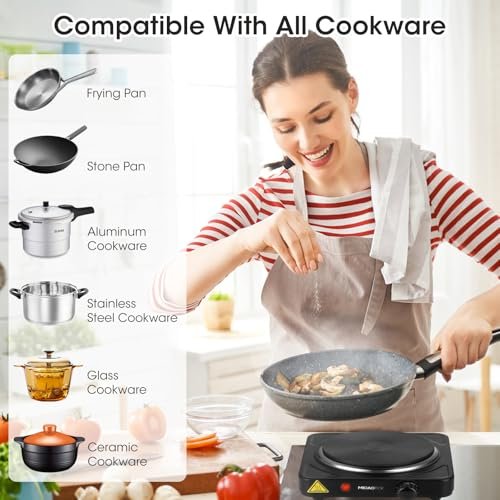
MIOAOTCE hot plates use resistive heating — cast iron, copper, aluminum, and non-magnetic stainless steel all work, no new cookware required.
The electric skillet line carries a ceramic nonstick coating certified free of PFAS, PFOA, lead, and cadmium — no Teflon chemistry, no hedging on what's in the coating.
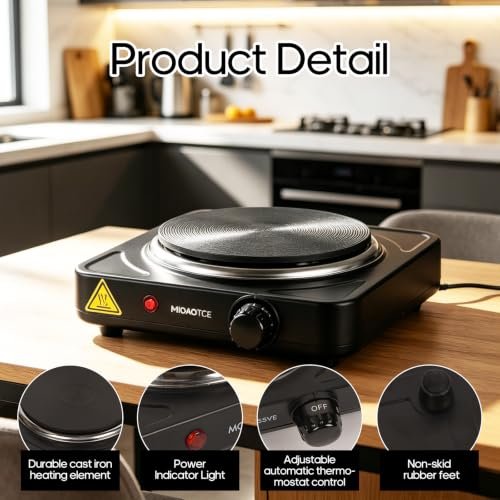
All four MIOAOTCE appliances include automatic shutoff when temperatures exceed safe limits, plus non-slip rubber feet that keep the unit planted during cooking.
The 3-in-1 indoor grill's motor-driven 360° rotating system holds 14 skewers and turns them continuously — even browning on all sides, hands-free.
Three different cooking situations — solo meals in a dorm, family-size cooking without a range, indoor BBQ in an apartment — call for three fundamentally different appliances. MIOAOTCE's lineup covers all of them without overlap: pick the format that matches your actual kitchen setup, not just the one with the most features listed.
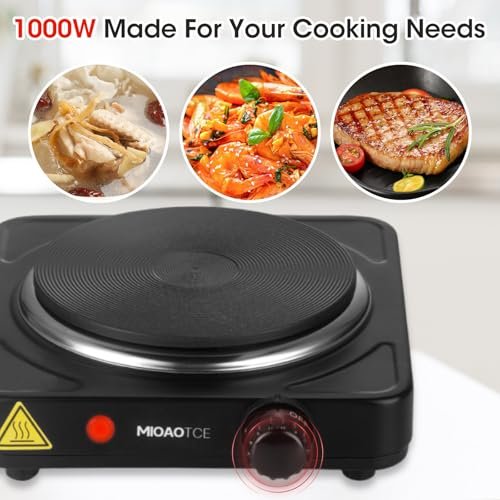
A 6.1-inch cast iron heating plate — not a coil — pulls 1000W and distributes heat more evenly than a coiled element, with longer heat retention once it's up to temperature. Five knob-controlled settings, 3.67 lbs, and it works with every cookware material including copper and non-magnetic stainless steel.
The cast iron plate holds heat steadier than a coil burner — better for sustained cooking tasks like simmering a sauce or finishing a protein, especially in a dorm or RV where you're working with one pan at a time.
See on Amazon
Two independent coil burners — 5.2 inches at 800W and 6 inches at 1000W — for 1800W total output across a 9.7" × 17" stainless steel footprint. Each burner has its own five-setting knob, an indicator light shows when the element is live, and non-slip rubber feet keep the unit from sliding at 4.59 lbs.
The only product in the MIOAOTCE lineup that lets you run two cooking tasks simultaneously — sauce on the small burner, vegetables on the large one — in a format that fits on a standard dorm desk or RV countertop.
See on Amazon
The heating element is built into the pan itself — 1500W distributed across the full 12-inch ceramic surface, not concentrated under a 6-inch burner. PFAS/PFOA/Lead/Cadmium-free nonstick coating, 2.6-quart capacity, tempered glass lid, detachable temperature dial, and cool-touch handles across a 12.6" × 12.6" × 4" overall footprint.
Full-surface heating eliminates the center hot spot you get when a 12-inch pan sits on a 6-inch burner — and the PFAS-free ceramic certification directly addresses the most common nonstick safety concern in buyer reviews.
See on Amazon
Three cooking modes in one 11.14" × 15.15" × 8.3" unit: 360° auto-rotating kebab skewers (14 included), flat griddle, and a third mode for broader grilling. The enlarged drip tray catches grease before it vaporizes, a built-in timer handles cook time, and all contact surfaces — nonstick plates, drip tray, tempered glass lid — are removable for cleaning.
The rotating skewer motor is what separates this from every contact grill at this price: 14 skewers turn continuously without any input from you, and the drip tray's job is to collect fat before it hits the heating element — that's the actual mechanism behind smokeless operation.
See on AmazonDiscover the full product lineup with current selection on Amazon.
All products on AmazonThe right MIOAOTCE product depends almost entirely on one question: how many people are you cooking for, and what's your actual kitchen situation? A dorm student reheating soup needs something completely different from someone running Thanksgiving side dishes on a second burner. Here's how to route yourself to the right product fast.
The Cast Iron Single Burner 1000W is built for exactly this. At 3.67 lbs and with a 6.1-inch cast iron heating plate, it fits on a desk, a dorm shelf, or the corner of a studio counter without taking over the space. One person, one pan, one meal at a time — eggs in the morning, stir-fry at night, pasta whenever. The 1000W output handles all of it without tripping a 15-amp dorm circuit.
Don't expect it to boil a gallon of water fast. That's not what it's for.
The Double Burner Hot Plate 1800W is the only product in the MIOAOTCE lineup that lets you run two cooking tasks simultaneously. The 5.2-inch burner runs at 800W; the 6-inch burner runs at 1000W. Sauce on one side, vegetables on the other — or keep one burner on low to hold a finished dish warm while you finish the second. The stainless steel body and coil elements heat up faster than the cast iron single burner, which matters when you're timing multiple components.
A separate hot plate and your existing skillet will almost always leave you with a pan that overhangs the burner element, creating a cold ring around the edges. The 12-Inch Electric Skillet solves this differently — the 1500W heating element is built into the pan itself, covering the full 12-inch cooking surface. No center hot spot, no cold outer ring. The 2.6-quart depth handles most family-size meals, and the PFAS/PFOA/Lead/Cadmium-free ceramic coating wipes clean without soaking.
This is also the product to choose if nonstick coating chemistry is a real concern for you. It's the only format in the lineup with a verified clean-coating certification.
The 3-in-1 Rotating Indoor Grill is categorically different from the other three products. It's not a skillet alternative or a supplemental burner — it's a dedicated indoor BBQ appliance with a 360° auto-rotating skewer system that holds up to 14 skewers simultaneously. If you live in an apartment without a balcony, or you're in a building where outdoor grilling isn't allowed, this is the only product in the lineup that actually solves that problem. The enlarged drip tray handles grease collection so it doesn't hit the heating element and smoke.
For everything else — kebabs, grilled chicken thighs, vegetables on skewers — it's genuinely hard to replicate this with a flat griddle or a contact grill.
Hot plates have a reputation problem. A lot of buyers have owned one that barely simmered soup, let alone seared anything. Whether that's the product's fault or a mismatch between expectations and wattage is worth understanding before you buy — because the honest answer is: it's usually both.
A 1000W hot plate — which includes the Cast Iron Single Burner 1000W — reaches genuine cooking temperatures for single-serve meals. Scrambled eggs, a fried egg, sautéed vegetables, stir-fry in a 10-inch pan, pasta in a medium pot, grilled cheese. These all work. The cast iron plate retains heat better than a coil element, which means it holds temperature more consistently once it's up to heat.
What 1000W won't do quickly: boil 8 quarts of water for a large pasta pot, maintain a rolling boil in a stockpot, or run two pans simultaneously. For that, you want the 1800W double burner — or you need to right-size your pot. A 2-quart pot of pasta water gets to boiling on a 1000W plate. A 6-quart pot takes much longer and may never get there fast enough to be practical.
The Double Burner Hot Plate 1800W draws 800W from the smaller coil and 1000W from the larger one. Running both simultaneously at max gives you the total 1800W output. That's meaningfully more capable than a single 1000W burner — you can maintain a proper boil in a medium pot, run a sauce and a sauté simultaneously, or cycle faster between dishes.
But 1800W across two coil burners still isn't the same as a 240V residential range element running at 2,400W+ on a dedicated circuit. If someone tells you a double-burner hot plate completely replaces a full stove for a family of four cooking complex meals every night, that's overselling it. For supplemental use, small households, and situations where you don't have a stove at all, it absolutely works.
The 12-Inch Electric Skillet uses a ceramic nonstick coating certified free of PFAS, PFOA, lead, and cadmium. That's a real material specification, not just a label — ceramic coatings don't contain PTFE (the compound in Teflon that releases fumes at high temperatures), so the concern about toxic off-gassing from overheated nonstick pans doesn't apply the same way.
Ceramic coatings do wear over time. A few things extend their life significantly: cook at medium heat rather than maximum whenever possible, avoid metal utensils (silicone or wood only), and hand-wash rather than run through the dishwasher. A ceramic coating that's treated well lasts meaningfully longer than a cheap PTFE coating used carelessly. One that's scraped with a metal spatula and run through the dishwasher weekly won't survive long — that's true of any nonstick surface.
The 3-in-1 Rotating Indoor Grill uses an enlarged drip tray positioned below the cooking area to catch fat before it drips onto the heating element. Grease that lands in the tray doesn't vaporize into smoke — that's the actual mechanism. It works well for lean proteins: chicken breast, lamb and beef kebabs, shrimp, vegetables. These don't generate the volume of grease that overwhelms the tray under normal cooking conditions.
Very fatty cuts — chicken thighs with skin, fatty pork belly — at maximum temperature will generate more grease than the tray can manage without smoking. That's true of every "smokeless" indoor grill at any price point; the laws of physics apply uniformly. Set realistic expectations: lean proteins at medium-to-high heat stay genuinely low-smoke. Fatty cuts at max heat, less so. The transparent glass lid also helps by containing steam and light splatter while still letting you watch the food.
For RV and van-life cooking, the single most important spec isn't brand name or burner diameter — it's wattage versus your power setup. Get that relationship wrong and you're either tripping breakers or buying a product that can't actually cook at full output. Here's how MIOAOTCE's lineup maps to the most common shore power and inverter situations.
The Cast Iron Single Burner 1000W draws exactly 1000W at full output — right at the edge of a 1000W inverter's rated capacity. In practice, most quality 1000W inverters can handle this for the short bursts a hot plate actually needs (heating up, then cycling to maintain temperature), but you'll want to run nothing else on that circuit simultaneously. Pair it with a 1500W pure sine wave inverter if you want comfortable headroom.
The 6.1-inch cast iron plate works with cast iron skillets, stainless steel pans, copper cookware, and aluminum — whatever's already in the van. No induction-compatible cookware required, no having to audit your pan set before a trip. That's the practical advantage that makes a resistive hot plate worth considering over an induction cooktop for mobile cooking.
A standard 15-amp, 120V campground hookup delivers about 1,800W of usable capacity (15A × 120V = 1,800W). The Double Burner Hot Plate 1800W pulls exactly that at combined maximum output — meaning you can run it at full capacity on a 15-amp hookup, but with essentially zero headroom for anything else on the same circuit. Run the two burners alternately rather than simultaneously at max if you're also running a phone charger or a small fan on the same line.
A 30-amp hookup gives you roughly 3,600W of capacity — enough to run the double burner at full tilt alongside other appliances without concern.
The Cast Iron Single Burner 1000W is the most practical choice for solo travelers and couples in a van or smaller Class B setup. At 3.67 lbs and compact dimensions, it stores easily. The cast iron plate holds temperature steadily, which matters when you're cooking over inconsistent power from a generator or inverter that fluctuates slightly under load.
The Double Burner Hot Plate 1800W makes more sense for Class A or fifth-wheel setups with reliable 30-amp shore power and more counter space. At 9.7" × 17" and 4.59 lbs, it's not a small footprint — but it covers the full range of meal prep that two people doing real cooking actually need: a boiling element on one side, a sauté element on the other.
The 12-Inch Electric Skillet and the 3-in-1 Rotating Indoor Grill are less practical for mobile setups — not because of power requirements (both run at 1000W–1500W), but because of footprint and depth. The skillet's self-contained design means one less pot to pack, which some RV cooks find genuinely useful. But it's a situational advantage rather than a clear win for every setup.
The Overland Bound community has been consistently clear on one point: for mixed pan sets that include copper, aluminum, and non-magnetic stainless steel — which is most people's real cookware situation after years of accumulating pieces — a resistive electric burner beats induction every time. Induction only works with ferromagnetic cookware. Your grandmother's copper-bottomed pot, your aluminum camping pan, your non-magnetic stainless skillet — none of those work on induction. All of them work on a MIOAOTCE hot plate. On the road, where replacing cookware isn't convenient and buying specialty pans isn't appealing, that compatibility matters.
MIOAOTCE hot plates work with every common cookware material — aluminum, copper, cast iron, stainless steel, ceramic — because they use resistive heating, not electromagnetic induction. That distinction has real consequences for anyone comparing a hot plate to an induction cooktop before buying.
Induction cooktops heat pans by generating an electromagnetic field that induces a current in the pan itself. For this to work, the pan has to be made of a ferromagnetic material — meaning it has to be magnetically responsive. Cast iron works. Some stainless steel works. Aluminum doesn't. Copper doesn't. Non-magnetic stainless steel doesn't. If you hold a magnet to the bottom of your pan and it doesn't stick, the pan won't heat on an induction cooktop at all.
MIOAOTCE electric hot plates generate heat through a resistive element and transfer it to the pan through direct contact — no electromagnetic field involved. The pan material is irrelevant. If it sits flat on the surface, it heats.
This is the part most product listings gloss over, and it matters. The Cast Iron Single Burner 1000W has a 6.1-inch heating plate. The Double Burner Hot Plate 1800W has a 5.2-inch element and a 6-inch element. A 10-inch or 12-inch skillet will overhang those burners significantly — the outer 2–3 inches of the pan won't receive direct heat from the element.
That's not necessarily a dealbreaker. Heat does conduct outward through the pan, especially in heavier-gauge cookware like cast iron or thick stainless. But you'll get uneven results with large-diameter, thin-walled pans on a small burner. A 6-inch or 8-inch pan sits cleanly on the 6-inch burner and heats evenly. A 12-inch thin aluminum skillet on the same element won't.
The 12-Inch Electric Skillet sidesteps this problem entirely — its 1500W heating element runs across the full 12-inch base, so there's no mismatch between pan diameter and element diameter. If even heat across a large cooking surface is the priority, the self-contained skillet format is the better engineering answer than trying to run a large pan on a small standalone burner.
One thing that does affect performance on any resistive hot plate: warped or rounded-bottom pans. A pan with a bowed or convex bottom won't make full contact with the heating plate, which creates uneven heating and reduces efficiency. Cheap thin pans that have warped from thermal shock are the most common culprit. If your pan wobbles on a flat countertop, it'll perform worse on a hot plate than a pan that sits flush. This isn't a MIOAOTCE-specific issue — it applies to any contact-heating cooktop.
We flagged this roundup because smokeless claims are exactly where indoor grill marketing tends to overreach — and this channel puts five competing models through the same conditions to see what actually holds up. You'll see how each grill manages grease and heat, which is the part that determines whether you're cooking dinner or airing out your apartment. We don't make the list ourselves, but watching how the competition performs tells you a lot about what separates a well-designed drip system from one that just looks good on a spec sheet.
Three different product categories, three different specs that matter most. The tables below break down the hot plates side by side and give you the full spec sheet on the electric skillet and indoor grill — so you can match the right format to the way you actually cook.
| Feature | Cast Iron Single Burner 1000W | Double Burner Hot Plate 1800W |
|---|---|---|
| Total Wattage | 1000W | 1800W (800W + 1000W) |
| Number of Burners | 1 | 2 |
| Burner Size | 6.1 inches | 5.2 inches and 6 inches |
| Heating Element | Cast iron plate | Coil |
| Housing Material | Cast iron | Stainless steel |
| Temperature Settings | 5 levels, knob control | 5 levels per burner, knob control |
| Indicator Light | No | Yes |
| Weight | 3.67 lbs | 4.59 lbs |
| Footprint (D × W × H) | 5" × 13" × 10" (approx.) | 9.7" × 17" × 3" |
| Cookware Compatibility | All types including copper, aluminum, cast iron | All types including copper, aluminum, cast iron |
The cast iron single burner is the better pick for solo cooking — it retains heat longer between temperature adjustments, which matters when you're simmering a sauce and walking away. The double burner is for anyone running two cooking tasks at once: sauce on the smaller 800W element, a sauté on the larger 1000W side. At 4.59 lbs and 17 inches wide, it's still portable, but it needs counter space.
| Specification | Detail |
|---|---|
| Cooking Surface Diameter | 12 inches |
| Interior Depth | 1.6 inches |
| Capacity | 2.6 quarts |
| Wattage | 1500W |
| Material | Aluminum with ceramic nonstick coating |
| Nonstick Certification | PFAS-free, PFOA-free, lead-free, cadmium-free |
| Temperature Control | 5 settings, detachable dial |
| Lid | Tempered glass, included |
| Handles | Cool-touch |
| Overall Dimensions | 12.6" × 12.6" × 4" |
| Model Number | AD-P32 |
| Included Components | 12-inch electric skillet |
The 1.6-inch interior depth is worth noting before you buy: it's enough for pancakes, stir-fry, fried eggs, and shallow sautés, but not for anything that needs significant liquid volume — a deep stew or a covered braise wants a deeper vessel. The 1500W heating element runs through the full base of the pan, so unlike a burner-plus-pan setup, there's no cold ring at the edges.
| Specification | Detail |
|---|---|
| Wattage | 1000W |
| Cooking Modes | 3 (rotating skewer, flat griddle, and combination) |
| Skewer Capacity | 14 skewers |
| Rotation System | 360° auto-rotating motor |
| Lid | Removable tempered glass |
| Drip Management | Enlarged removable drip tray |
| Controls | Temperature dial and built-in timer |
| Nonstick Coating | Yes, on cooking plates |
| Removable Parts | Cooking plates, drip tray, lid |
| Overall Dimensions | 11.14" L × 15.15" W × 8.3" H |
| Color | White |
| Model Number | AD-C1000 |
| Included Components | Kabob skewers, grill |
At 15.15 inches wide and 8.3 inches tall, the 3-in-1 grill is the largest appliance in the MIOAOTCE lineup — it needs dedicated counter space and isn't a pack-and-go option. The built-in timer is genuinely useful here: with the skewers rotating automatically, you set the time, walk away, and come back to evenly cooked kebabs rather than monitoring them in person.
"I've been using the cast iron burner in my dorm for about four months. It gets hot fast — eggs, stir-fry, ramen, reheating leftovers — handles all of it without tripping the breaker. My one complaint is the 6.1-inch surface means a 10-inch pan overhangs quite a bit, so I stick to my 8-inch skillet. For solo cooking, though, it does exactly what I needed."— Jordan M., College student cooking in a dorm without a stove
"Bought the double burner as a backup when one of my stove elements died. The 1800W total is real — I had a sauce simmering on the smaller burner and chicken sautéing on the bigger one at the same time. Heat-up is quick for a coil. It's been six weeks and I still haven't gotten the stove element repaired, which probably tells you how I feel about it."— Renee T., Homeowner using it as a supplemental burner during a kitchen repair
"The PFAS-free certification is what got me to try the 12-inch skillet. I'd been avoiding nonstick for years. Ceramic cleans up easily — a paper towel handles most of it after cooking. The 1.6-inch depth is shallower than I expected, so for anything with sauce I have to be careful. But for everyday eggs, fish, and pancakes, it's been a solid replacement."— Dana W., Home cook who switched from stainless steel over nonstick toxicity concerns
"We live in a fifth-wheel and shore power is what we cook on. The single cast iron burner pulls 1000W, which our inverter handles cleanly. Knob control is simple enough to use in a small galley without thinking about it. Works with our cast iron and our stainless — didn't have to replace anything. Three months on the road, no issues."— Greg F., Full-time RV traveler cooking on shore power and an inverter
"The rotating grill is legitimately useful. I was skeptical — every 'smokeless' indoor grill I'd owned before was a lie. The drip tray on this one actually works for lean proteins. Chicken thighs and vegetables, no smoke alarm. Very fatty sausages at max heat? Some smoke. Set realistic expectations and it delivers. The 14-skewer capacity means I can cook for four people in one batch."— Marcus L., Apartment dweller with no outdoor grill access, cooking for a household
"I use the 12-inch skillet for weekend batch cooking — usually a big scramble, hash browns, or pan sauce. Heats evenly across the surface, which was my main worry after reading reviews of other budget skillets. The detachable dial is convenient for moving it to the table. Honestly could use a slightly larger capacity for batch cooking, but the 12-inch handles two to three portions without crowding."— Priya S., Home cook who batch-cooks on weekends and needs reliable even heat
A 1000W hot plate — including the MIOAOTCE Cast Iron Single Burner 1000W — reaches temperatures sufficient for searing, stir-frying, and bringing small volumes of liquid to a boil. Realistic limits: it will not boil a large pasta pot quickly, and high-volume batch cooking will tax it. For solo meals and standard sautés, 1000W is plenty. The cast iron plate retains heat longer than a coil at the same wattage, which helps maintain temperature when food hits the surface.
Cast iron plates and coil burners heat differently. The MIOAOTCE Cast Iron Single Burner 1000W takes slightly longer to reach full temperature than a coil, but holds heat more consistently once it's there — useful for sustained cooking like simmering or pan sauces where temperature drops when food is added. Coil burners, like the elements on the Double Burner Hot Plate 1800W, heat up faster and cool faster. For quick tasks, coil is fine. For steady-temperature cooking, cast iron has a real advantage.
Induction cooktops are more energy-efficient and offer more precise temperature control in higher-end models. But they only work with ferromagnetic cookware — cast iron and magnetic stainless steel. MIOAOTCE electric hot plates use resistive heating, which works with every cookware material: copper, aluminum, non-magnetic stainless steel, and cast iron. For anyone who already owns a mixed set of pans and doesn't want to replace them, that's a concrete practical advantage. For raw cooking performance with compatible cookware, induction is faster.
The MIOAOTCE 12-Inch Electric Skillet uses a ceramic nonstick coating certified free of PFAS, PFOA, lead, and cadmium — none of the compounds that have driven nonstick toxicity concerns on cooking forums and subreddits. Ceramic coating chemistry is fundamentally different from PTFE (Teflon): it doesn't off-gas at high temperatures the way PTFE does when overheated. That said, ceramic coatings are not indestructible — metal utensils and high heat over time will degrade the surface. Treat it like you would any nonstick: medium heat, silicone or wood utensils, hand-wash.
Hot spots are the most frequent complaint — cheaper models with undersized or poorly distributed heating elements cook unevenly, leaving a hot center and cool edges. The MIOAOTCE 12-Inch Electric Skillet runs a 1500W element through the full base, which addresses this directly. Beyond heat distribution: nonstick coatings wear faster than buyers expect if used on high heat or with metal utensils, and shallow depth (1.6 inches on the 12-inch model) limits what you can cook with liquid. These are real constraints worth knowing before you buy.
The MIOAOTCE 3-in-1 Rotating Indoor Grill is specifically designed for indoor use. Its enlarged drip tray catches grease before it contacts the heating element — that's the actual mechanism that reduces smoke, not just a marketing claim. For lean proteins like chicken breast, kebabs, and vegetables at moderate temperatures, the tray handles the job. High-fat cuts at maximum heat will still produce some smoke. The removable tempered glass lid contains heat and minimizes splatter. If you're cooking in a small apartment, crack a window for very fatty items.
The MIOAOTCE 12-Inch Electric Skillet draws 1500W at full power. Run it for one hour and it consumes 1.5 kWh — roughly the same as running a hair dryer for an hour, or about half what a full-size oven uses in the same period. Most cooking sessions run 15–30 minutes, not a full hour, so real-world consumption is lower. At the US average electricity rate of around $0.16 per kWh, a 30-minute cooking session costs approximately $0.12.
Yes — the MIOAOTCE 12-Inch Electric Skillet is well-suited to fried eggs. Set the temperature dial to setting 2 or 3 (low-to-medium range), let the surface preheat for a minute, and the ceramic nonstick coating releases eggs cleanly without added oil if the surface is properly heated first. The tempered glass lid is useful here for covering eggs without lifting and losing heat. The 12-inch surface fits two to three eggs comfortably side by side.
Wattage draw is the critical number. The MIOAOTCE Cast Iron Single Burner 1000W pulls exactly 1000W — compatible with a standard 1000W inverter and a 15-amp shore power circuit without issue. The Double Burner Hot Plate 1800W pulls 1800W total, which requires a 20-amp circuit or a higher-capacity inverter. Both models work with any cookware you're already carrying — no induction restrictions. The cast iron single burner's knob control requires no learning curve, which matters in a small galley.
The five discrete settings across MIOAOTCE's skillet and hot plate line — rather than a continuous variable dial — cover a practical cooking range. Setting 1 handles keeping food warm and melting butter. Settings 2 and 3 cover low-to-medium tasks: scrambled eggs, pancakes, gentle sautés. Setting 4 handles chicken thighs, pork chops, and most pan-frying. Setting 5 reaches searing temperatures for steak and high-heat stir-fry. You won't get a degree readout, but five well-spaced bands cover what most home cooks actually need.
MIOAOTCE's product decisions make sense when you look at who's actually buying countertop cooking gear: people without reliable access to a full stove. Dorm residents with a single low-wattage coil that barely boils water. Studio renters without a range. RV owners on shore power who need something that works with whatever pots they're already carrying. Apartment dwellers who want to cook kebabs indoors without a smoke event. The lineup — a cast iron single burner, a dual-coil double burner, a self-contained electric skillet, and a 3-in-1 rotating indoor grill — doesn't try to do everything. It solves four specific problems.
The product specs reflect consistent priorities. Resistive heating instead of induction means all-cookware compatibility — copper, aluminum, non-magnetic stainless steel, cast iron — without requiring buyers to replace what they already own. Ceramic nonstick coatings certified free of PFAS, PFOA, lead, and cadmium address the single most active concern in electric skillet communities: what's in the coating and what happens when it gets hot. Knob controls instead of touch screens mean the appliances work with wet hands and don't require consulting a manual mid-cook. These aren't accidental choices.
The 3-in-1 Rotating Indoor Grill — the brand's most specialized product — shows the same logic applied to a different problem. Indoor BBQ appliances mostly fail in one of two ways: they smoke badly enough to be unusable in an apartment, or they require constant manual attention (turning skewers, monitoring heat). MIOAOTCE's answer is a motor-driven 360° rotation system that handles even cooking automatically and an enlarged drip tray that addresses smoke at the source by collecting grease before it vaporizes. It's a product built around the specific frustrations of the apartment grill-seeker, not a generic contact grill with a smokeless label attached.
Here's what you need to know before picking an electric skillet, hot plate, or indoor grill — real specs, actual use cases, no marketing fluff.
MIOAOTCE is a kitchen appliance brand building countertop cooking gear for people who cook without a full stove — dorms, small apartments, RVs, and supplemental kitchen setups. The product line spans electric hot plates, ceramic nonstick skillets, and a 3-in-1 indoor rotating grill.
Contact MIOAOTCE directly through their official Amazon store page for product questions, order issues, or warranty inquiries. The MIOAOTCE Store on Amazon is the primary point of contact and carries the full product lineup.
All MIOAOTCE products are sold through the MIOAOTCE Store on Amazon.com, where current pricing, availability, and buyer reviews are updated in real time. Check Amazon for the most current stock status and any applicable promotions.